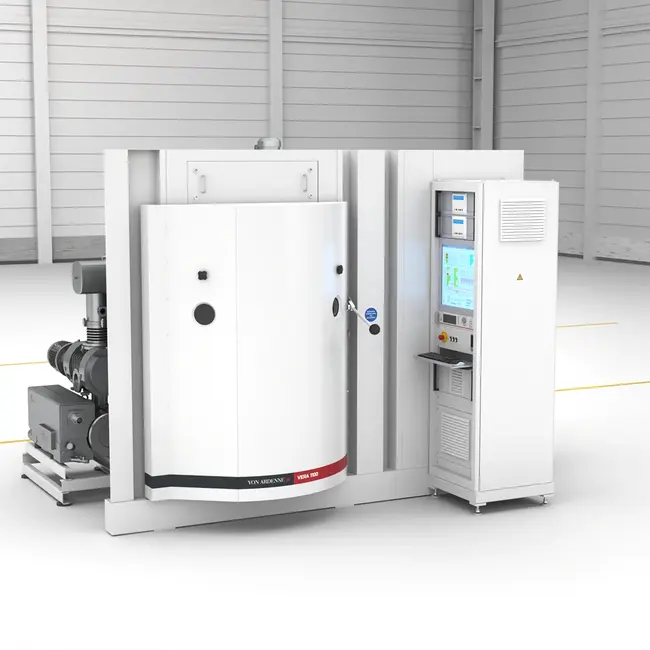
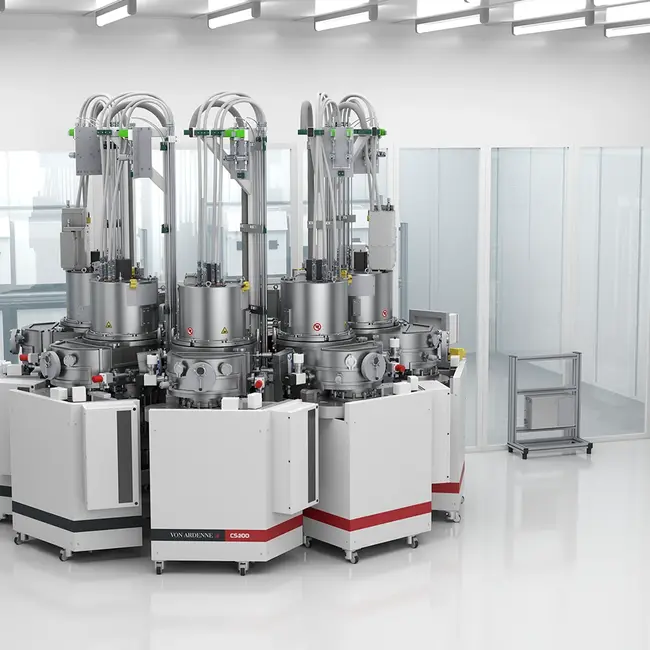
Because no handling is required between individual deposition steps, complex stacks comprising 5 to 1,000 layers can be produced. The OPTA X handles different form factors with diameters or widths of up to 300 millimeters. For optimal coating results, the proprietary Compound Assisted Reactive Sputtering (CARS) and Meta Mode* technologies are used. Both sputtering modes can deliver high quality Oxides at high rates of approximately 0.5 nm/s on full batches of, for example, 13 mm x 300 mm wafers or carriers. Reactive and non-reactive sputtering are also available.
For maximum flexibility, magnetrons and/or plasma sources can be integrated at up to five positions per coating side, and these positions can be equipped with different materials. In-situ measurement technology is available for optical monitoring and can be used for inline process control to optimize optical filters in real time based on physical modeling during the coating process.
The OPTA X is equipped with an automatic, modular transfer system for the safe loading of different substrates. The semiconductor version of the OPTA X allows for full OHT automation and substrate transfer from SMIFs and FOUPs, while the optics version uses adaptable carriers for flexibility and multi-load lock chambers for particle reduction and high productivity during multiple unattended deposition batches.
*
The CARS mode combines magnetron sputtering from ceramic targets with an RF-ICP plasma process. During each rotation, a sub-stoichiometric oxide or nitride monolayer is deposited and subsequently fully oxidized or nitridized to form a stoichiometric layer.
The Meta Mode uses a metal target in the magnetron sputtering compartment and an RF-ICP plasma process for subsequent oxidation or nitridation. A thin metallic layer is deposited in the magnetron sputtering compartment and then fully reacted in the RF-ICP plasma zone. This keeps the metal target clean and avoids the conventional target-poisoning issue.